tattoos
Showing posts with label Chinese Pop. Show all posts

Saturday, November 19, 2011

From Records To Night Spots: Irene Yap Part II

When Irene Yap decided to turn professional, a singing contract during her school holiday in 1971 took her to Genting Highlands, Malaysia, where she performed and was accompanied on stage by The Commandos from Indonesia.
This new life lasted for 15 years and included stage appearances with Rahim Hamid (Singapore's Nat King Cole) and The Pebbles, Sonny Bala and The Moonglows and many other top pop Singapore bands.

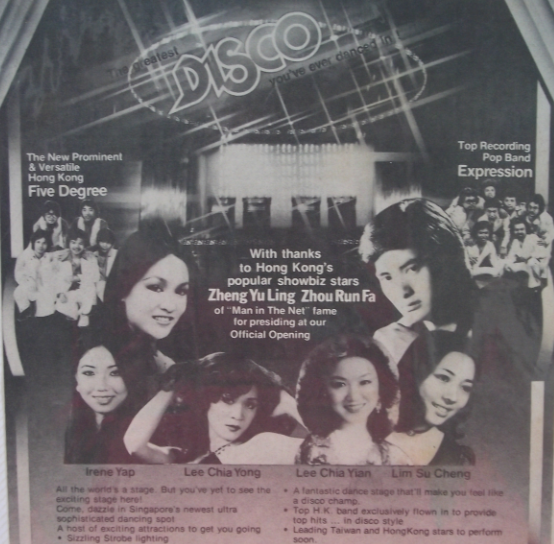
She entertained at a string of hotels all over Singapore from about 1972 to 1980 including the Apollo at Ion Bar in Kings at and the Ambassador in the East Coast. Her nightclub stints included the El Amigo, Lido Deluxe (image 2), the Capuccino at Plaza Singapura and other popular spots.

A journalist from an English newspaper, remarked in an article that Irene "has a voice that is light, almost ethereal." With a voice so heavenly like the songbird herself, it was not a wonder that she had encore performances at the clubs that she was in. Irene remembers that in a particular nightspot "management kept asking me to come back..." She did, and remained a resident singer for almost five years. And that told a lot about her!

There were moments in her youthful career that Irene sung duet with guitarist and keyboardist Edmund Tan. They entertained audiences with hits like , Jackson, Love Me With All Your Heart, He'll Have To Go. Her nightly club acts widened her repertoire and she sang in other languages too.

Irene added, "The regulations in the nightspots were very strict. Being underaged I had to apply for a licence to perform. We were not allowed to patronise customers and had to wear decent costumes."

But it was a varied, colourful and successful life's journey for this songbird. From the first vinyl record contract offered, where the Charles Lazaroo Orchestra accompanied her in Pretty Ribbons and where she went through "hard gruelling sessions of recordings", up to the time that she retired to get married, she never regretted a moment.

Irene moved to the US for a short while, living in two major cities. She had been a housewife since except for a comeback at two nightclubs in 1995. During her very early years one newspaper headlined her as the "pint-sized veteran of show business".

Today this true veteran reminisced, "When you start singing at such a tender age, you never think about anything else. Singing becomes your life and doing something you love. No regrets except that it had taken some of my childhood."

Irene's story reveals her positive attitude towards a life and career that she chose to take. It is a music journey spanning quite some years but she has made it a successful one. Thank you Irene for sharing your past moments with me. I appreciate it very much.

Images from Irene Yap Collection: 1) Night club poster. 2) Chinese New Year songs with two other singers. The three of them did a Chinese Variety Show appearance and also recorded children's songs.

Original article: Andy Lim. All copyrights reserved.

Wednesday, November 16, 2011

Irene Singing At 11 And 10 Albums By 14: Part 1

In 1966 when Irene Yap (image: 1,2) was only 11 years young she was asked by a Mr Heng to sing with a Singapore guitar group called The Sandboys while watching them during a rehearsal. According to Irene, the gentleman was affiliated to White Cloud Records (more popular with the production of Chinese pops) and signed her up for a recording contract after listening to her voice.

Irene made her first vinyl singing the very popular Pretty Ribbon by Engelbert Humperdinck. But her version was different because she sung it in both English and Chinese. It was a hit and sold about 8,000 copies! She carried on with White Cloud and in the next four years, up to the time she was 14 in 1970, Irene had released seven EPs and three LPs.

Irene recalled that before the singers had final recording sessions they had to be properly trained. She continued, "So when I was only eleven Mr Heng sent me for vocal training by Liang Pin a famous Hong Kong singer then. Besides singing scales I had to do the Por por mor fer, a Chinese pronunciation course."

As her popularity peaked, Irene was well publicised by the local English papers. Stories about this youthful singer, her recordings and pictures appeared in The Straits Times, New Nation, Singapore Herald, Eastern Sun and other vernacular newspapers. Within the short span she had appeared on the little home screen during Chinese Variety Show produced by RTS (Radio Television Singapore) and other programmes like Take Four, The Guthrie Hour and on the Malay Variety channel.

With such a success story and because she wanted to pursue her love for singing Irene made a decision to turn professional and it was during her school holiday in 1971 when Irene decided to...

(More about Irene in the next posting and what the newspapers say about her and the special licence she had to obtain to perform because of her age.)

Do you remember Irene and her White Cloud recordings? Tell us.

Images: Irene Yap Collection. Copyrights Reserved.

Article: by Andy Lim as told by Irene Yap.

Wednesday, September 7, 2011

Shao Fong Fong Sings In Impeccable English


(Josephine Shao, Siew, Xiao, Siao, Fong Fong, Fung Fung, Fang Fang. Same name but spelt differently.)

I had often seen 60s Hong Kong movies which starred Siew Fong Fong and it didn't matter then whether I understood the language or dialect that the script was in. She was a joy to watch and what attracted me then was her pretty face and her ability to entertain her audience with her Jane Bond kiss-bang, wuxia chops, sword wielding choreography and hippy-hippy-shake dancing.

Examples were movies like, SwordsOf Swords, I Love A-Go-Go, The Lady Killer and many more. She was one Chinese actress that most fans in the 60s would remember. On the silver screen Josephine Siao was a major star in both Mandarin and Cantonese movies. In that decade alone she had acted in more than 200 movies and those days the Hong Kong film studios churned out films like factories produced chopsticks. Personally she felt manipulated, like a "puppet."

Delving into her life and history, I found that she was born in Shanghai in 1947 with a career spanning some five decades, from her beginnings as a child star up till the highly respected professional that she is today. She was the most popular princess in the group of actresses termed the 'Seven Cantonese Princesses' and became one of the biggest teen idols in Hong Kong along with frequent co-star Connie Chan Po Chu.

Unlike many child stars, Siao made a successful transition to adult stardom, winning so many awards and remaining one of Hong Kong's most prolific and popular actresses today. Having largely missed out on a formal education because of her acting career as a child, Siao pursued her studies in later years despite the handicap of increasing deafness and the demands of raising a family. She holds an MA in Child Psychology and is also a published author.

Digging into my drawers lately, I managed to find some western pops by Shao Fong Fong on EMI vinyls (images). And the recordings were proof enough of the fluidity and ease with which she used the English language. The lyrics were beautifully enunciated and her gentle, soft but clear voice was sufficiently suitable for the covers she was interpreting as she delivered them with grace and dignity. These few western covers she did were a contrast to many of the Cantonese and Mandarin songs she sung on screen and those recorded on other vinyl labels.

Her diction and phrasing reminded me of Malaysian teacher and pop singer Frankie Cheah's English language recordings on EMI. (Click 'Frankie Cheah on 'Label' below to read posting.)

Vinyl Notes: EMI ECHK 527 (1969). Bluer Than Blue, Who Will Buy this Wonderful Morning, Running Free, Goodbye. EMI ECHK 523 (1968). L.O.V.E, Love, Ding Dong Song, Kiss Me Goodbye.Images/Original article: Andy Lim Collection. Information from Websites.

*Notes from a Website about the actress:

Josephine lost all the hearing in her right ear at age two and has become nearly deaf in her left ear since 1990 so decided to retire for good. Fredric Dannen relates the following about his meeting with Josephine Siao - who he noted has impeccable English.

"At her request, we met in the conference room of a hotel, because, she explained, 'my gadgets do not work so well in noisy places.' Siao did not seem to miss a word I said, and I thought perhaps she had exaggerated her condition, until Ann Hui (the director of Summer Snow) later told me that Siao often has to lie down after a conversation, because the strain of using her aid left her exhausted.I was all the more amazed at Siao's acting skill - her deafness is indiscernible in her movies - and all the more grateful for her interview."
From: http://hkmdb.com/db/people/bio.mhtml?id=2222&display_set=eng

Sunday, May 1, 2011

Stylers Band 1971 Casino Song In Fujian Dialect


Two casinos have been built in the southern part of Singapore and they have been in the news these past months. One monolith stands tall bestriding the entrance of Marina Bay and the other is situated at Sentosa Island.
It is appropriate now to revive a rib-tickling, made-in-Singapore song about a gambling man who tries his hands at the gaming table. And the band responsible for this rollicking deal? The Stylers! The versatility of this home grown garage group is legendary. They recorded the humorous piece called, Our Casino Song in 1971. It is sung in Hokkien by Stylers' lead guitarist John Teo (image: centre man).

Hokkien or Fujian is a Chinese dialect which originated in the Fujian Province of China. This dialect is understood by many people living in the South East Asian region. Although it is not as widely spoken as Cantonese, the dialect can also be heard in the West. But whether it's in Hokkien or English, the lyrics run along a similar theme; that if you go to the casino be prepared to lose all your money.

However, if the listener still needs to understand the lyrics, here's the literal translation in English. Meantime, just enjoy the beat and the music. Does the tune sound familiar?

Our Casino Song

(Chorus repeated after each verse) Aiyoh, my money is gone, is gone, aiyoh...

Translation:

I played gin rummy /Loved the indulgence /Never thought that my wallet /Would 'follow them' /I haven't got a cent 'by my side.' /Went to Toa Payoh, Lorong 3 /(A place in Singapore) /Gambled everything away /Including my ring and wages /With nothing left to my name /But it's useless to regret /Gamblers get muddled /And become promiscuous /Abandoning their wives /Advice to others not to/Make the same mistake/Gamblers have no future.

Image 1 from: Antelope Record CTEP 1041 - The Stylers 8 Hits For Your Party Non-Stop Dancing.

Image/Original Article: Andy Lim.

Our Casino Song: You Tube Video on Right Bar by MrRainbow64.

Thanks to Randy Lee (image: far right) and Alvin Tan for translation.

Sunday, February 6, 2011

New Orleans Jazz Bands And Chinese Funeral Bands


As a child I remember street music in Singapore which comes from Chinese funeral processions. These funeral bands play melodies from both Chinese and English pops. One particular pop song that I can still recall, Today, (You're) Not Coming Home (Jin Tian Bu Hui Jia 今天不回家), has been played so many times at Chinese funeral street marches that it's been accepted as the unofficial theme song for the occasion (Image 2: a band at Kim Yam Road taken in 1970 in Singapore).

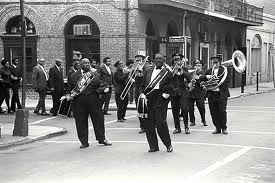
Books from the US that discuss the history of jazz music claim that jazz bands began from dance bands or social orchestras. These were African American bands that played on the streets in New Orleans, U.S.A. officiating at funeral processions. They play solemn music on the way to the burial yard and hot jazz on the way back (Image 1: a New Orleans jazz funeral).

It is common knowledge in the 60s that some Singapore band boys who play in the night-clubs freelance and work as funeral musicians in the day. Again the parallel; New Orleans dance orchestras do not confine themselves to playing in the ballrooms but played at funerals. Nothing to be ashamed of because it's honest living.These funeral bands could comprise from eight members onwards and the instruments included trumpets, trombones, snare drums and cymbals.

The Chinese funeral bands have the same number of people with similar instruments. During a bigger and longer procession at a Chinese funeral (indicating the wealth of the deceased), more instruments could be used, like the larger bass drums and a tuba. When questioned why music is played during such a tear-jerking occasion, the band members explain that the noise drives evil spirits away. Comment?

Original article: Andy Lim

Image 2: National Heritage Board, Singapore.
Image 1: http://www.allaboutjazz.com
(GARY MOORE PASSED ON 6TH FEBRUARY, 2011. GARY GUITAR GREAT.)

Friday, January 28, 2011

This Linchong EP Needs Interpretation: Anyone?


The only EP (Blue Star NE 1014) that I possess of Jimmy Linchong because it was offered to me at a discount and because I remember watching him on television and admired his looks.
The National Museum screened his movie, The Singing Thief in June, 2009 where he acted with Lily Ho (sexy, screen siren of the sixties). But the above song selection is not from the movie.
If Chun See or anyone else can help to translate the cover title and 6 song titles into English, I'd be grateful.
Image: Andy Lim Collection.

Wednesday, January 26, 2011

Lam Chun See Remembers Teresa And Jimmy

THANK YOU CHUN SEE: Read his comments under Jimmy Linchong's posting. Ayo Mama or Ai Qing Nali Lai is by Teresa Teng. She learnt this song together with Rasa Sayang when she stayed in Indonesia. Rasa Sayang and Ayo Mama originated from the Maluku Islands (Spice Islands) of Indonesia.

Doesn't matter if you can't read Chinese. Enjoy song on the Right Bar >>>>>

印度尼西亚民歌

小河弯弯 流水不断来
河里的水草
跟着漂过来
流水长在 长流那天外
问一声河里水草哪里来

哎哟 妈妈
莫非也像我的恋爱
哎哟 妈妈
可是来的这样奇怪
哎哟 妈妈
怎么你不讲个明白
谁知道我的爱情哪里来

小河弯弯 春风吹过来
河边的花香
跟着飘过来
遍地花开 芬芳到心怀
问一声春天从哪里来

哎哟 妈妈
你可不能不理不睬
哎哟 妈妈
我的寂寞情意难挨
哎哟 妈妈
给我怎么样的安排
你可叫我怎样的安排
谁知道我的爱情哪里来

Ayo Mama: Indonesian lyrics (literal translation):

Ayam hitam telurnya putih (Black chicken too has white eggs)
Mencari makan di pinggir kali (Searching for food by the lakeside)
Sinyo hitam giginya putih (Dark-skinned bride has white teeth)
Kalau ketawa manis sekali. (When she smiles, she's so sweet)

Ayo mama, jangan mama marah beta (Oh mum, don't you scold me)
Dia cuma cuma pegang beta (He's just holding her playfully)
Ayo mama, jangan mama marah beta (Oh mum, don't you scold me)
Lah orang muda punya biasa. (It's natural with the young)
Anyone willing to help with the Mandarin translation? Doesn't matter anyway. It's the beat that matters. Cha-cha-cha!!!

Monday, January 24, 2011

The Stylers Celebrate Chinese New Year In Style

There's a truly fabulous website on The Stylers and I am sure my namesake Andy who created it will not mind if I connect this particular posting to the site. It's a Stylers bunny year. Thanks again Andy and Randy. Without these two gentlemen we would have lost a treasure trove of Stylers goodies.

Sunday, January 23, 2011

Jimmy Linchong: Had Looks Only Elvis Could Match

He was handsome and had looks that only Elvis Presley could match. In fact some fans said he looked like The King. It was a matter of opinion but he could hold an audience in the 1960s, both on stage and on the screen.

Originally known as Lin Hsi-hsien, Jimmy Lin Chong was born in 1934 to a Taiwanese politician with a Japanese wife in Tainan, Taiwan. He graduated from the Tamkang Junior College of English (now Tamkang University).

His started his career in 1955 as a film actor and when he completed his military stint in 1957 he was invited to play in Taiwanese and Mandarin films. In 1962, Lin studied in Japan and when Hong Kong had become a dreamland for those interested in films.

A leading Japanese film company signed a contract with Lin, enabling him to play in Hong Kong-Japan co-productions like: A Star Of Hong Kong and Tokyo, Hong Kong, Hawaii. Lin’s popularity was extended to Hong Kong in 1968 when he became a hit with his avant-garde costumes and performance. He was just as popular in Singapore with a generous fan base. I remember watching him on TV and enjoying the moment.

It was obvious that the Shaw Studios recognised his talent and popularity. He became an actor with Shaw Brothers and played a leading role in a musical called, The Singing Thief. It was directed and written by the well accepted Chang Cheh. The musical drew crowds and Lin contined with two more films, The Singing Escort and Tropicana Interlude.
Do you know anything more about Jimmy Linchong?

Sunday, January 16, 2011

P. Ramlee's 'Bujang Lapok' On A Chinese Record Unique Indeed: Bau Asem, Ketiak Siapa Busok?


Chinese Pop Instrumental: A-Go-Go And Off-Beat Cha-Cha Art Sea Record: MEP 3032.

There were hundreds of instrumental groups in the 60s that catered to the Chinese pop markets in Singapore, Malaya and Hong Kong. Some of them had been featured many times on this blog.

These bands included Maurice Patton and The Melodians, Charlie and The Boys, The Travellers, The Silver Stones, the popular Stylers and more. The songs were usually covers of Western pops.

Tian Lian Band:

The genre of music was familiar too since these bands recorded 60s tunes mainly for dancing. But the name TIAN LIAN BAND (images) was a surprise - a very Chinese group indeed! Never heard or seen a record by this band. After checking some websites I found that this particular band had recorded other songs on Art Sea Record.

P. Ramlee:

But what is more surprising is the song on side two. Unless you are familiar with Malay pops, Pok Pok Bujang Lapok is a tongue-in-cheek about bachelors. It is composed by P. Ramlee and used in his movie with the same title. The other three songs include, When Will You Return (tagged as 'a Chinese song'), Young Ones (a Cantonese song) and So Lonely (a Hokkien song). A gimmick perhaps?

Swinging Skippers:

Even the group name of the dancing girls in the photographs caught my eye. They are called, The Swingin' Skippers. The girls must have been popular then to have their names displayed on the cover. Don't you find their costumes so informal and simple? That's Singapore street wear in the 60s. Not much different from today? And off-beat cha-cha definitely symbolises Chinese pops.

Bolshoi Ballet Orchestra:

P. Ramlee's music is internationally acclaimed that it has even been played by The Bolshoi Ballet Orchestra of Tashkent.

Images/Original article: Andy Lim Collection.


Saturday, January 8, 2011

樱花 Sakura n The Quests: R n R Yodelling Guy


Read comments on this Sakura recording (You Tube: by EHT123) in the previous posting below:

One Of The World's Greatest EP Album Covers Features 60s Sakura Singing John Lee Hooker


On November 29th 2007, an EP featuring Sakura's (Ying Hua) Puppet On A String (image 1) was posted, not too negatively, on a Website about The World's Greatest LP Album Covers, 45's too (image 2). Well, it's the honest truth:

"What could be better than a Singapore singer covering western pop songs in broken English with a fuzz-guitar backing. Here for your enjoyment is Sakura’s four- track 1967 EP featuring 'Puppet On A String' plus six superb tracks from her album 'Sakura Goes Boom Boom'.

Sandie Shaw notoriously disowned the ’60s Eurovision novelty song 'Puppet On A String' but Sakura Teng has made it her own, and even poses as puppets (and puppeteer!) on the sleeve. And what the hell is she wearing? Presumably silver tights and baby doll dresses were all the rage in Singapore in ‘67. Chinese singers famously have trouble singing western lyrics so you have to admire Sakura who not only impersonates Elvis on 'Rock ‘n’ Roll Yodelling Guy' but also (you guessed it) yodels. Is there anything this woman can’t do!

But save room for her take of the John Lee Hooker classic from her album 'Sakura Goes Boom Boom' which has to be heard to be believed, and the fuzz guitar-driven cover of Connie Francis’ 'Stupid Cupid'. Sakura is backed by a band called The Quests who were seemingly the in-house band at EMI-Columbia, Singapore and also back other singers, including Rita Chao.

Note: the back of the album bears the advertising legend: ‘Sakura also goes bazazz with Max Factor."

Article by: David Noades (Thank You, David)
So my dear readers, what do you think of David Noades' comment? Are we a novelty?
From: http://lpcoverlover.com/2007/11/29/china-dolls/
(REMEMBERING ELVIS PRESLEY: 76 YEARS YOUNG TODAY: 8TH FEBRUARY, 2011).

Wednesday, October 13, 2010

Dorothy And Vampires - All-Girl Group (Pt II)


The image on the right, taken from a souvenir magazine, shows The Vampires. From the vinyls recorded and publicity given, the girls were very popular and had appeared in a number of variety shows and private functions.
The description and position of each member in the magazine image is clear. From Dinner & Dance Magazine - 2nd October, 1965, "standing (left to right): Connie Fong is 18 and is a student at the Nanyang Academy of Arts. She plays the rhythm guitar and took up music some six months ago.

Rebecca Fong (with moon-glasses) is 18 and the lead guitarist and leader of the group. She is a student of the Sacred Heart School and took up music a year ago.

Front row (left to right): shows Gladys Ang, 17 years and is a student of Geylang Methodist School. She took up music nine months ago. Cynthia Fong is in the centre and attends Fairfield Methodist School. She took up the drums a year ago. Montaz Akib is the 2nd lead guitarist, is 16 and student of Geylang Methodist School. She took up music a year ago.

They had all gone for a TV audition and were accepted to appear on the small screen, so be on the lookout for this sensational teenage group. They are under the able hands of *Harry Martinez, Singapore's well-known music tutor."

The left image shows a Philips (438302 QE) recording of the same group. It features the same members (I think?) accompanying a vocalist called Dorothy. They pressed four Chinese (Mandarin) songs. These girls are unique within the Singapore 60s music circuit because I cannot think of another all-girl guitar group that plays Chinese music. Can you?

The band is known as Du Le Di in Chinese and the four songs translated into English are: Love Is Like A Balloon, Singing A Never Ending Song For You, Ah Lah Nah (Alanah) and Lian Hen (another Chinese name?)

*(Harry Martinez lived at Siglap in the East Coast and was a popular music tutor in the 60s who talent scouted his own students and grouped them into successful pop bands. The Silver Strings was such a group.)

Were you one of the band members? Is this the same group that were with Satellite Records? Do write in to tell us.

Image/Original article: Andy Lim Collection.


Friday, October 8, 2010

Singapore Vampires At Cavanagh Bridge (Pt I)

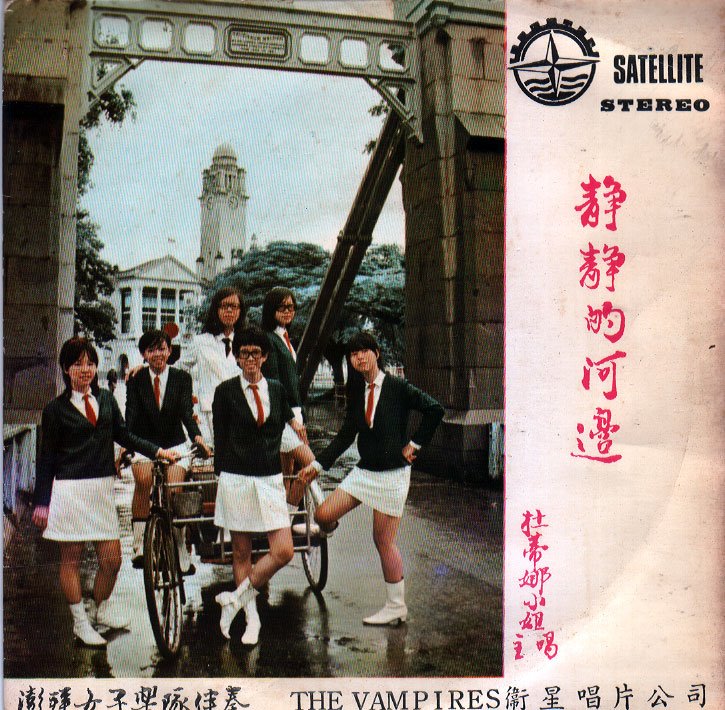
The ladies in the image were once a group that played Chinese (Mandarin) songs. They were called, The Vampires but they were not characters from the commercially successful Twilight series of the four vampire-themed fantasy romance novels by American author Stephenie Meyer.

In fact, these sweetheart Vampires from Singapore came at a different period and time. They haunted the dance halls, theatres and clubs in the 60s. This all-girl guitar group featured on the EP cover had only five members but added another, a vocalist called Du Di Na.

According to the sleeves, she joined the group two years prior to the release of this vinyl. Apparently the instrumental group itself had won many fans among Singapore youths and Du Di Na was added to front the original band.

From A blog called Mod-ified Music, one of the songs featured on the Satellite brand record was Han Yu Qu (Chilling Rain Song). It was a popular Chinese song instrumentalised by this group. The Vampires could have been just as successful in the mid-60s but without Bella Swan from Twilight fame.

Wearing dark jackets, short, tight skirts and white boots, the girls looked smart and neat, posing in front of heritage protected Cavanagh Bridge. Behind them is the Victoria Memorial Hall with its imposing clock-tower.

There were not many all-girl guitar groups in Singapore were there? Are you familiar with this group and do you know who they are?
Image/information: http://modcentric.blogspot.com/

Tuesday, August 17, 2010

Mystics - HK Pop Portuguese, Macao Descent

According to Hong Kong pop song enthusiasts, there were two different music scenes in the 60s. On one hand there were garage bands like The Mystics (image), Joe Junior & The Side Effects, Menace, Teddy Robin and the Playboys, Lotus, etc. Like our local Singapore bands The Trailers or The Quests, these groups generally sung in English and covered the latest top hits from the UK or the US.
On the other hand there were recording artistes from the Shaw Brothers film studio like Nancy Sit and Chan Po Chu who recorded Chinese versions of international hits. Remember Rita Chao and Sakura Teng? There were also a handful of studio musicians churning out instrumental versions of both Western songs and westernized Chinese songs as well; like The White Cloud Orchestra from Singapore 60s?
One reasonably popular band that had made it to the top was The Mystics. They followed the same formula like covering current 60s English language songs from the west. The group formed in 1965 during the golden years of Hong Kong’s music extravaganza and team members comprised Hong Kong citizens of Portuguese descent.
Again like Singapore's guitar groups, The Mystics were popular at teenage parties, tea dances, and recorded chart toppers with Diamond Record Company, a subsidiary of Polydor Records. They came in the usual LPs, EPs and singles format.
Some of the songs recorded were: I Can’t Help Myself, Sweet Soul Music, When A Man Loves A Woman, In The Midnight Hour, Going Out Of My Head, Don't Leave Me (Baby, Baby), What Makes, You Run, Ain't Proud To Beg, I Want To Talk With You, Somebody New, Song Of The Wind, One day and Send Her Back.
While some of these pops were covers, others were composed by band members Michael Remedios (vocals) and Tony Tavares (drums). The rest of the team were: Francis De Costa (guitar), Vasco De Costa (bass guitar), and Clifford Yim (keyboard). Don Choi joined in 1970.
Other line-ups included Ricky Gosano, Ricky Fung, Ricky Souza and Derek Turner. The website also claims that singer Michael Remedios still sings today. Not only has he a great voice, he dances well too. For his appearances he wears thick make-up.
One website wrote that the band was called, "The Bank Flat Boys" (translated from Cantonese) because members usually lived in the area populated by residents who worked in the commercial banks in Kowloon. This particular group was supposed to be Hong Kong's best soul band.
The Mystics' tea dances, HK variety shows, concerts and TV shows had a varied repertoire that also included selection peppered with soul spice like, Arthur Conley's Sweet Soul Music, Wilson Pickett's In The Midnight Hour and Chris Kenner's Land Of A Thousand Dances (Na, na, na, na, na...). The songs were hot choices at that time!
Like other groups in that era, they were just a band in a crowd until the emergence of drummer and guitar player Tony Tavares. He brought the group to a new height when they started recording originals. Popular compositions included, Send Her Back, Song Of The Wind and Somebody New. The group disbanded in 1971.
Information has been extracted and edited from:
http://www.helloaudience.com/cgi-bin/mailview.pl?id=108450_ucxH34

Friday, June 4, 2010

Asian 60s Music Hits Appeal To Western Ears

CDs like the above (image) are re-issues of 60s music recorded previously by our local Singaporean, Malaysian singers and bands who have put in much time and effort to press them on vinyls. Now these compilation CDs are for sale on the internet. Without copyright and free legal advice to help our musicians nothing can really be done to channel the earnings to them. But production of these yesteryear hit collections has been in practise for many years. So who cares anyway.
The writer below explained that the selection was his "favourite find" and he wasn't concerned which of them were hits but rather, which ones appealed to "this pair of western ears." Even the susu chap junjong jingle (Milkmaid Milk advertisment) attracted the writer's western ears. It is given away as a 'bonus' track. Interesting indeed. Perhaps the compilation is done and sold just to cover cost?
(Original article above: Andy Lim.)
Read the story below about this enterprising person who came to Singapore 11 years ago to buy up the vinyls:
“Funny thing happened to me back in 2001, during my first trip to Singapore. I was in a clothing store in Causeway Point, and an old ‘60s tune was blasting out of the stereo speakers. It sounded like your typical ‘60s pop hit, but the lyrics were sung in Malay! I was entranced, and wouldn’t be satisfied to just hear it just once. I spent the rest of my trip combing the local antique stores and flea markets, grabbing all the vinyl I could find.
My first purchase was The Mysterians’ Forget the Time b/w My Girl Les, found at an antique store on Orchard Road. The cover, featuring the band wearing black masks and standing in green background, is such a classic that I spent a few weeks admiring it before finally purchasing a turntable so I could hear it. But when I finally did, lo and behold, an obsession was born.
Nine years and five overseas trips later, my collection now boasts more than 600 rare titles from the region, which also includes Malaysia and Indonesia. In this first volume, I present a handful of my favorite finds. Some of these bands experienced regional success at best, while others disappeared after one or two recordings. Very few left behind any written history.
I didn’t concern myself with which songs were hits, but rather which ones happened to appeal to this pair of western ears. I have included a variety of tunes, from rockers to ballads, covers and originals, all sung in a variety of native languages. A few instrumentals have been thrown in for good measure. Now on to the music, Let's A Go, Go, on Silver Tortoise. CD."
Tracklist:
#1 Flamingo By The Bees, #2 One To Nine Walkin By Patrina, #3 The Second Spring By Hai Fei, #4 Just Because By The Dee-Tees, #5 You've Got To Move On By Leroy Lindsay with The Mysterians.
#6 Mean Woman Blues By Rocky Teoh, #7 The Girl From Alishan By The Blue Beats, #8 Let's A' Go-Go By Charlie and His Go-Go Boys, #9 Oh! Salina By M.Ishak Dengan Five-55, #10 Things We Said Today By S.K. Pauline.
#11 Bang Bang By Betty Chung, #12 Wooly Bully By Charlie and His Go-Go Boys, #13 Then I Kiss Her By Lotus Liew, #14 Mun Li By Orkes Tropicano, #15 Let's Dance By Lotus Liew.
#16 These Boots Are Made For Walkin By Charlie and His Go-Go Boys, #17 Swim Swim Swim (She and I) By The Spacemen, #18 Merindu Kasih By The Click IV Dan Jaffar-O, #19 My Girl Les By The Mysterians, #20 Dream Wonder By The Tones, #21 Beli-lah Susu Chap Junjong (Bonus track) By Malay-Tamil-Malay.
Just wondering. Collecting the vinyls can be an eye-opener because of the art work on the sleeve covers but listening to some of the songs? That is a problem. Not to sure about Betty Chung's, Bang, Bang (side-bar).
Article above flagged by: Mark Wong.
1) Another similar article posted on Sunday, March 14, 2010:

Wednesday, June 2, 2010

Pan Wan Tjing, Rebecca - Sings, Acts, Travels

Pan Wen Tjing or Rebecca Pan, born in Shanghai, China, is possibly one of the top divas from the 60s who still enjoys the privilege today, having accumulated about 50 years of show business experience.
In 1957, she began as a singer in a band at Hong Kong Caesar's Palace Nite Club where she replaced a friend for a few weeks. She gained a following, had the first ever fan club formed for her in HK and Nie, Nie, Wo, Wo became the theme song, written specially for her by Diamond Records where she cut her vinyls after going solo.
As she is able to sing in many languages namely: French, Italian, Arabic, Indonesian, Thai, Japanese, Malay, Mandarin, Cantonese, and English, Pan was able to tour the world. With her multi-lingual singing ability she recorded the international evergreen, Rose Rose I Love You (1961) in both Chinese and English. Another hit, Second Spring (1965) by Yao Min, followed. Pan also recorded Ding Dong Song with the success of the musical, The World Of Suzie Wong by Lionel Bart.
In 1972 when other singers were still struggling to achieve stardom on stage, Pan had already formulated her own Broadway-styled movie musical and acted in Pei Niang Niang. She even directed this movie which is better known as Madam White Snake among her English speaking fans. It is a modern interpretation of the classic Chinese folk tale and the fusion musical proved a controversy, but it drew crowds. If Loving You Means Hurting You became the most successful song from the show.
She had starred in more than half a dozen art-house films and won a Golden Horse Award (equivalent to the Hollywood Oscar) in a Hong Kong production called, Days Of Being Wild. Pan is so popular that her music can be heard in many Hong Kong films. One movie is In The Mood For Love with her interpretation of Bengawan Solo and another movie is Flowers Of Shanghai.
According to some websites, she was credited with introducing Mandarin songs to an international audience, became Hong Kong's biggest music export and had performed in Singapore, India, Thailand, Israel, Australia, England, France, Spain and the U.S. She is still known as the Travelling Star.
Did she sing her swansong in Singapore and retired afterwards? Anyone?
Edited articles from 2 websites: Andy Lim.

Tuesday, April 6, 2010

Bengawan Solo And Foreign Songs (Part III)

FOREIGN SONGS BECOME ENGLISH HITS (3):
ITALIAN: Nel blu dipinto di blu, known also as Volare is Domenico Modugno’s signature song. It is the only song ever by an Italian artist to reach number one on the US Billboard Hot 100 charts. His recording won the Grammy (1958) and is the only foreign-language recording sung entirely in Italian.
Written by Modugno himself and Franco Migliacci, it came in third in the 1958 Eurovision Song Contest. But only Dean Martin's version (1958) made its way into the hearts of many Singaporeans. Beats even Bobby Rydell's more upbeat version!

PERUVIAN/ANDEAN: El Cóndor Pasa or Flight of the Condor (1913) is a song by Peruvian composer Daniel Alomía Robles based on traditional Andean folk tunes. It is popular worldwide because it is covered by Simon & Garfunkel in their Bridge Over Troubled Water album (1970). This cover version is called El Condor Pasa (If I Could). When Simon heard a version called Paso Del Condor by Jorge Milchberg, he personalized it by adding his own English lyrics. They are all listed as songwriters in this version.
Perry Como released a cover of Simon's English version on his album It's Impossible. Simon & Garfunkel did release their version as a single in the U.S. and it reached 18 on the Billboard Pop Singles chart.
SPANISH: Singapore guitar groups are familiar with Perfidia (1939), The Ventures classic. It means faithless, treacherous or false and was written by Alberto Domínguez in the 1900s. Aside from the original Spanish, other renditions exist, including an English version by Milton Leeds.
The song became a hit for Xavier Cugat in 1940 and used by Chinese director Wong Kar Wai in some of his movies. Perfidia has been recorded by many artistes as early as the 50s, including Gene Autry, Charlie Parker, Mel Torme, Glenn Miller, Nana Mouskouri, The Shadows, The Ventures, Linda Ronstadt, Nat King Cole, Lawrence Welk, The Four Aces and Perez Prado.
INDONESIAN: Bengawan Solo (1940) in Bahasa Indonesia is by Gesang Martohartono and sung in kroncong style, a popular folk music with influences from the Portuguese. The Japanese, who occupied the country during World War II, brought the song to Japan afterwards. It has become an international hit since.
The song became popular amongst the Chinese community in SE Asia after Malaysian singer Poon Sow Keng recorded it in Mandarin for Hong Kong Pathe (1957). It was further boosted by Ms Koo Mei, who sang her version for Philips Records. Many Chinese language singers have written their own lyrics for the tune, making it one of the greatest classics in S.E. Asia.
The English recording of Bengawan Solo is called, By the River of Love from an early 60s Hong Kong record sung by Rebecca Pan. Sakura Teng and Mona Fong (image) sing it both in Chinese and English. While Teng heats it up, Fong gives it a cha-cha-cha beat!
And so this short journey ends in Asia again. We have come one full circle. If you happen to know of pop songs that have been translated into English, please write in.

Image: You Tube
Information: Wikipedia Songs
Original article: Andy Lim

Foreign Songs Become English Hits (Part I)

FOREIGN SONGS BECOME ENGLISH HITS (1):
It is a well-known fact that countless 60s popular and classical music from foreign countries become English language hits in the UK, US and other parts of the world. This posting will focus on some of these classics. We start in Asia.

MANDARIN: Rose, Rose, I Love You is an English adaptation of the Mandarin song, Méigui Méigui Wǒ Ai Ni by Yao Li (1940s), the only song written by a Chinese to become a major English language chart hit.

The English lyrics were written by a British DJ, Wilfred Thomas and recorded by 50s pop singer Frankie Laine and the Norman Luboff Choir, with Paul Weston and his Orchestra in 1951. The song, with different English lyrics, was also covered in the UK by Petula Clark (1951) and by Kyu Sakamoto (1960s).

JAPANESE: The second Asian song, Sukiyaki by Kyu Sakamoto went to the top in 1963. So far, this is the only song by a Japanese singer to hit the ceiling in the U.S. The Japanese title is Ue O Muite Aruko, which means I Look Up When I Walk. It is definitely a Singaporean favourite even till today. The Blue Diamonds (Holland) recorded it with English lyrics in 1963 and personally, is one of the best versions!

FILIPINO: Another Asian pop classic, the very famous, Anak (1971) or child is a Tagalog song written and sung by Filipino folk-singer Freddie Aguilar. It has been translated to over a hundred local and international languages. The English version, by Aguilar, is a direct translation of the original and should not be missed by anyone who loves a beautiful rendition of an exceptionally sad song.


Image: google

Information: Wikipedia Songs

Original Article: Andy Lim


blogger templates | Blogger